 Add to Chrome
 Add to Firefox
 Add to Edge
ERNIE 5.0 Technical Report
Feb 04, 2026
In this report, we introduce ERNIE 5.0, a natively autoregressive foundation model desinged for unified multimodal understanding and generation across text, image, video, and audio. All modalities are trained from scratch under a unified next-group-of-tokens prediction objective, based on an ultra-sparse mixture-of-experts (MoE) architecture with modality-agnostic expert routing. To address practical challenges in large-scale deployment under diverse resource constraints, ERNIE 5.0 adopts a novel elastic training paradigm. Within a single pre-training run, the model learns a family of sub-models with varying depths, expert capacities, and routing sparsity, enabling flexible trade-offs among performance, model size, and inference latency in memory- or time-constrained scenarios. Moreover, we systematically address the challenges of scaling reinforcement learning to unified foundation models, thereby guaranteeing efficient and stable post-training under ultra-sparse MoE architectures and diverse multimodal settings. Extensive experiments demonstrate that ERNIE 5.0 achieves strong and balanced performance across multiple modalities. To the best of our knowledge, among publicly disclosed models, ERNIE 5.0 represents the first production-scale realization of a trillion-parameter unified autoregressive model that supports both multimodal understanding and generation. To facilitate further research, we present detailed visualizations of modality-agnostic expert routing in the unified model, alongside comprehensive empirical analysis of elastic training, aiming to offer profound insights to the community.

NTIRE 2020 Challenge on Image Demoireing: Methods and Results
May 06, 2020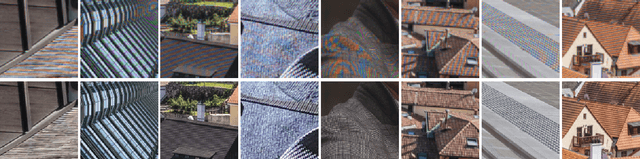
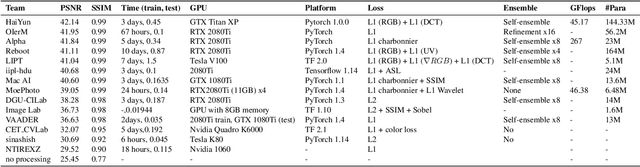
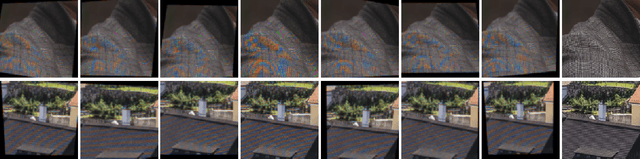
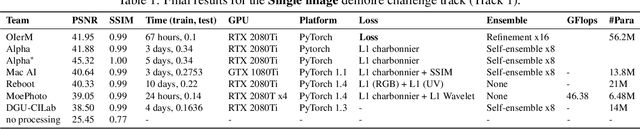
This paper reviews the Challenge on Image Demoireing that was part of the New Trends in Image Restoration and Enhancement (NTIRE) workshop, held in conjunction with CVPR 2020. Demoireing is a difficult task of removing moire patterns from an image to reveal an underlying clean image. The challenge was divided into two tracks. Track 1 targeted the single image demoireing problem, which seeks to remove moire patterns from a single image. Track 2 focused on the burst demoireing problem, where a set of degraded moire images of the same scene were provided as input, with the goal of producing a single demoired image as output. The methods were ranked in terms of their fidelity, measured using the peak signal-to-noise ratio (PSNR) between the ground truth clean images and the restored images produced by the participants' methods. The tracks had 142 and 99 registered participants, respectively, with a total of 14 and 6 submissions in the final testing stage. The entries span the current state-of-the-art in image and burst image demoireing problems.
AIM 2019 Challenge on Image Demoireing: Methods and Results
Nov 08, 2019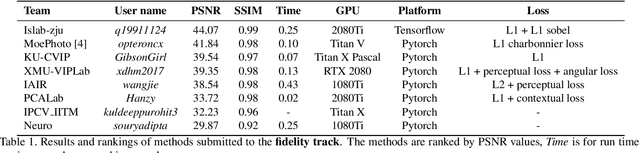
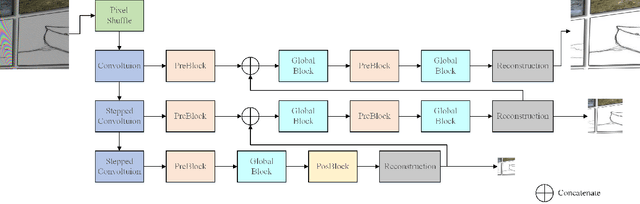
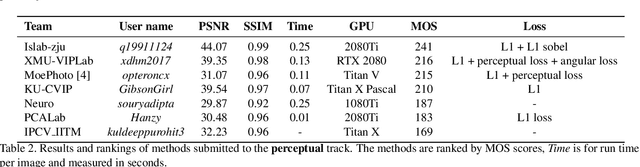
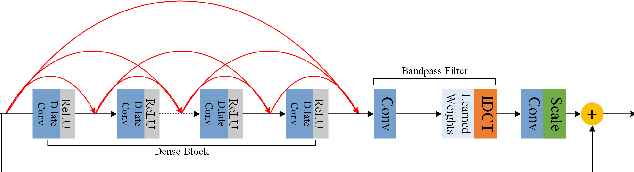
This paper reviews the first-ever image demoireing challenge that was part of the Advances in Image Manipulation (AIM) workshop, held in conjunction with ICCV 2019. This paper describes the challenge, and focuses on the proposed solutions and their results. Demoireing is a difficult task of removing moire patterns from an image to reveal an underlying clean image. A new dataset, called LCDMoire was created for this challenge, and consists of 10,200 synthetically generated image pairs (moire and clean ground truth). The challenge was divided into 2 tracks. Track 1 targeted fidelity, measuring the ability of demoire methods to obtain a moire-free image compared with the ground truth, while Track 2 examined the perceptual quality of demoire methods. The tracks had 60 and 39 registered participants, respectively. A total of eight teams competed in the final testing phase. The entries span the current the state-of-the-art in the image demoireing problem.